Saturday, January 31, 2015

Blog Post 3


Peer Editing

After reading the blog and analyzing the other material required for this blog post I learned a lot about the rules for peer editing. The basic definition of peer editing is "working with someone your own age usually someone in your class to help improving, revise, and edit his or her work". All of the resources provided gave the same three steps to peer editing compliment, give suggestions and corrections. The main idea is to stay positive while giving completing those three steps to peer editing.

There were also more detailed instructions given in order to effectively peer edit. When giving suggestions the resources provided explained some examples of suggestions would be; word choice, details, organization, sentence structure and topic. When giving this suggestion the peer should always remember to stay positive and be specific. The last step to a peer editing is correction some examples of correction that could be made are; punctuation, grammar, sentences and spelling.


https://search.yahoo.com/search;_ylt=AlAgerHmCeFJcTcHPGZFMiabvZx4?fr=yfp-t-901-s&toggle=1&fp=1&cop=mss&ei=UTF-8&p=picture%20of%20students%20peer%20editing


Saturday, January 24, 2015

Blog Post 2


Mr. Dancealot

In, Mr. Dancealot video, I think that central message is that, a student can’t learn from listening to a lecture. Students need to have hands on experience and more project based learning, to better understand the concepts that are being taught. The author of this video really makes his point with the video, because it is obvious that dancing is a very “hands on skill”. I do agree with the author of the video, students need to learn most subjects and skills by actually attempting and working through the material or skill first hand.

Teaching in the 21st Century

In the video he describes teaching, as something more now than it was before. The video states that as educator we are no longer the main source of information we are now more of a filter. The video suggest our role is to provide; content, facts, dates, formula, research, theories, stories, information. The conflict with that is that students now have access to that information at their fingertips all the time. So the role as a teacher has shifted. We no longer provide all the information. Now it is our job to teach students how to use the information overload they have access too. Teachers have to embrace the information students already have and teach them to use their resources correctly. The video also gives examples of other subjects that have to be taught to students for example; plagiarism, slander, copyright, crowdsourcing etc. I believe Roberts is correct in his way of thinking that the ways of teaching in the 21st century are different. I hope to use the new technology in my future classroom. I think it will be my responsibility to help students understand their tech resources, but also to teach them to filter through and find the accurate information. Even in the elementary level I would love to use some of the resources shown in this video such as podcast, google docs, you tube etc.

Networked Student

I found the video very interesting, all the different ways this student connected and gathered information independently but with the support of his teacher in a nontraditional way. The answer the question” why did the networked student need a teacher?” did not surprise me very much. I believe that as educators that is always or role to allow our students to work through information and guide them however needed. Educators are not doing their students any justice by handing them the needed answers or information easily.

Harness your Students Digital Smarts

I believe the thesis of the video is like the teacher said at the end of the video that she believes in “turning school upside down and empowering students to share with other students”. Meaning that she doesn’t believe in the concept that a teacher has to master a topic or skill before she teaches that concept or skill to the students, she likes the idea of allowing the students to learn and teach as well. I really found the information in the video inspiring and knowledgeable. I have never even heard of “digital citizenship” which they were working on in the video. I really think that it is beneficial for students to learn from one another, and it doesn’t always have to be the teacher in the driver seat.

Flipping the classroom

I think the idea of “flipping the classroom” is very useful and it is more like what we do in college, which would prepare students for a college experience. I also think that it can only be effective if students and parents are active participants in the idea. I can see a lot of parents being not on board with this type of idea. I personally am a parent and a future teacher and love the idea, I think there is a lot of valuable time wasted in the classroom explaining and teaching the basic ideas of a topic when those could be taught via videos. Making the students watch the videos and complete the practice problems and come to school prepared for the lesson, teaches them accountability and responsibility.

Bringing the Locker Room Into the Classroom

This is my favorite of all the resources for this weeks blog assignments. I love the idea of engaging our students in the same way the coaches are in the locker room. If every student was just as active in the classroom learning as they were in the locker room or at practice of the sport that they choose to participate in, the possibilities of learning levels are bound to be increased. The idea of "teaching the system" which sounds so simple. But as students we can think about when we start a new class and how much time we actually spend trying to figure out how the class works. I can recall spending more time trying to figure out "the system of the class" than the actual material for the class. 

student with laptop


Friday, January 16, 2015

Blog Post 1


 I have taken EDM 310 previously, so I have a good idea of what to expect from the class. With that being said I am still fearful about the class because I obviously wasn't successful the first time. The class requires a lot of time and "tech" knowledge that I am not familiar with, and really doesn't compare to any other class that I have taken before. I think time management and learning how to do things I haven't done before are going to be the most difficult aspect of EDM 310. I think the best way for me to tackle the most difficult aspects of EDM 310, is to stay organized, keep up with current assignments and give myself enough time to get help with projects that require to learn a new skill. I don't have any specific questions right now, but I am sure once assignments start rolling in I will have plenty of questions.  

http://www.tropicanagardens.com/home/images/stories/carolyn%20planner.jpg

Thursday, January 15, 2015

Practice Blog

I am 29 years old, I have lived in several different places including Pensacola, Florida, Oklahoma, Texas and Philadelphia, Pennsylvania and Montgomery, AL. I recently moved back to Mobile from Denison, Texas I had lived in Texas for the last 5 years. I moved to Texas 5 years ago from Montgomery because I had my second daughter who was born with major health issues, and had to transferred to "Children's Medical Center" in Dallas, TX. She is healthy now and so we moved back to Mobile, Al over the summer. This is my second semester at South, and I am attending USA because it is convenient, and offers the education major that I am desiring.

I am a single mother of three children I have a 10 year old daughter, 7 year old daughter and a 4
year old son. Raising my children is my primary focus in life at this point, along with obtaining my teaching degree. I also enjoy riding 4 wheelers with my friends in family. I enjoy cooking, I love having friends and family over and cooking for them.


When I started college I was a nursing major, but found myself being a single mom of three small children and started seeking other alternatives. While coaching my daughters church league of basketball one season, I felt so passionate about helping young children. I had a good feeling being a inspiration to the kids on the team. One little boy in particular, whom had a terrible home life, but I really connected with helped me to decided that education major is where I needed to go with my life. The fact that I will have the same schedule as my children also encouraged me to enter the field of education.


Saturday, April 5, 2014

Project 12b


Blog Post 11


In Brian Crosby’s video, Back to the Future, Crosby discusses the technology they use in class, how they use it, and the impact it leaves on their education.Crosby’s students each have their own computers to us, with which they use for blogging, creating wikis, and posting pictures on the class flikr account.One project that the students did was called “My High Hopes.”In this project, students wrote down what their high hopes were in their lifetime. They sent up a balloon with a camera and their high hopes attached. This way they could see the view from the balloon. The students then wrote a story as if they were the balloon. The first half was written before the balloon was sent up, then finished after the the balloon was sent up.I think we can learn that students can learn through projects like this. It seems like students are just having fun, but at the same time they are learning, too.
balloon
Paul Anderson discusses the Blended Learning Cycle in his video. In blended learning, learning in the classroom, online, and mobile is combined, while the learning cycle involves an engaging question, exploration, explanation, expansion, and finally evaluation. Anderson uses the acronym “QUIVERS” for his blended learning cycle, which stands for question, investigation, video, elaboration, review, and summary quiz. It is important to start with a good question to get students interested in what they are going to be doing. Next you investigate. In investigating, students can experiment. Next is video. With a video, students can watch this on their own, leaving the instructor time to work with other students. Then there is elaboration which is going further into the subject. Students can be assigned further reading material to learn more about the subject. Next is review in which Mr. Anderson meets with students and asks them questions to make sure they understand the subject are. Last, students are given a summary quiz that tests them on the things they have learned in the previous steps. I think Anderson has a good system for his students. I think it incorporates all the different styles of learning. It starts off with a good question to get students engaged, but it also incorporates experimentation for students that are more hands on and reading for those kinds of learners. Not only are there these things but there is a video for visual/auditory learners.
Blended Learning Cycle

Mark Church discusses a great way to make kids think, in Making Thinking Visible. The students watched a video the previous day on early human beginnings. He asked the to come up with a headline that would capture what they thought it's about. The students were asked to write their headline on a long sheet of paper. They then hung them up on the bulletin board. After a few weeks of the class going over human beginnings in more detail, they would then see if their headline would be the same. The idea is that when you make thinking visible then the students will learn more.

Making Thinking Visible is a great way to show the students how their thinking evolves. Students can view how they thought at the beginning of the lesson and then what they think at the end of the lesson. When students first hear about a topic, they form an opinion before they are knowledgable. After the students learn about the topic, their opinion will most likely change. This teaches students how to think more in depth before forming an opinion. Making thinking visible makes learning inevitable.

In the video Super Digital Citizen, Sam Pane was teaching his fifth grade class about digital safety as well as being a good digital citizen. Sam Pane quoted Spiderman "With great power, comes great responsibility." He had his students talk in their groups about what power the internet gives people. After the class discussed the powers of the internet and what a digital citizen was, Sam introduced the assignment of creating a digital citizen superhero and a comic strip showing proper internet safety and incorporating real images of themselves. Sam took about five minutes to show the students how to create their digital superhero. The students then created a digital citizen superhero and their comic strips. Once all the student created their comic strip, the students then did gallery walks. Gallery walks are when the students view and critique their peers work.

Educators can learn a lot from Sam Pane. He incorporates superhero quotes into his lecture to get his students engaged. The quote he uses "With great power, comes great responsibility" makes the students think about the power of the internet and responsibility they must use on the internet. The internet is a powerful tool we can use to learn about anything. Students need to know how to use the internet safely. Creating a comic strip that has self images makes the lesson personal for the students. In the comic strips, the students can come up with unsafe situations and have their digital superhero save them. They are learning through their creativity, without even realizing their learning. The comic strip also helps the students practice writing stories. The fact that he calls the peer review a gallery walk also gives his students a sense of accomplishment. They consider themselves an artist. The students also learn from performing a gallery walk. The students learn by reading their peers comic. They get new ideas as well as reinforcing the idea of using internet safety.
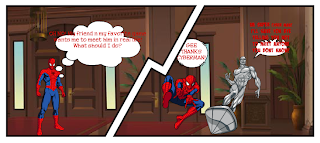
When your using the internet make sure you are being responsible. Project Based Learning

This video is about three teachers that worked together to combine three subjects and make serious changes to the structure of the classroom in order to, provide a improved learning experience for their students. The teachers expressed in the video that they were faced with some major roadblocks while attempting to make this change. After attempting they soon realized they would have to get their administrates involved to help restructure the class times to make the plan work.

After restructuring their classroom they took entire morning to teach English, history and information processing the three teachers worked together and used project based learning to teach students beyond just the curriculum. The teachers in the video talked about how this gave them the opportunity to teach the students not just about the facts but about, being a good citizen and poverty. The teachers could take time with the students to critique their work and revise this allowed more time for feedback and better quality work.

Roosevelt PBL   

This video was basically just a break down of "Project Based Learning" and how this school was using it in their classrooms. The video explained how PBL was a "more in depth learning, based on real world instructions and research based". One of the teachers said something like " the students can really show they understand and not that they just kind of get but they passed the test".

The teachers in this video encouraged students to be involved in public speaking at a young age so that it wouldn't be such a struggle when they got older. The other key points made throughout the video about PBL were about student choice, giving students a sense of power and teaching them to be able t work in a group and communicate with each other.